Blog
Weaponized Ignorance: When Not Knowing Becomes Strategy
By Jay
Series: Leadership
Tags: leadership, organizational-behavior, accountability, systems-thinking, delegation, privilege
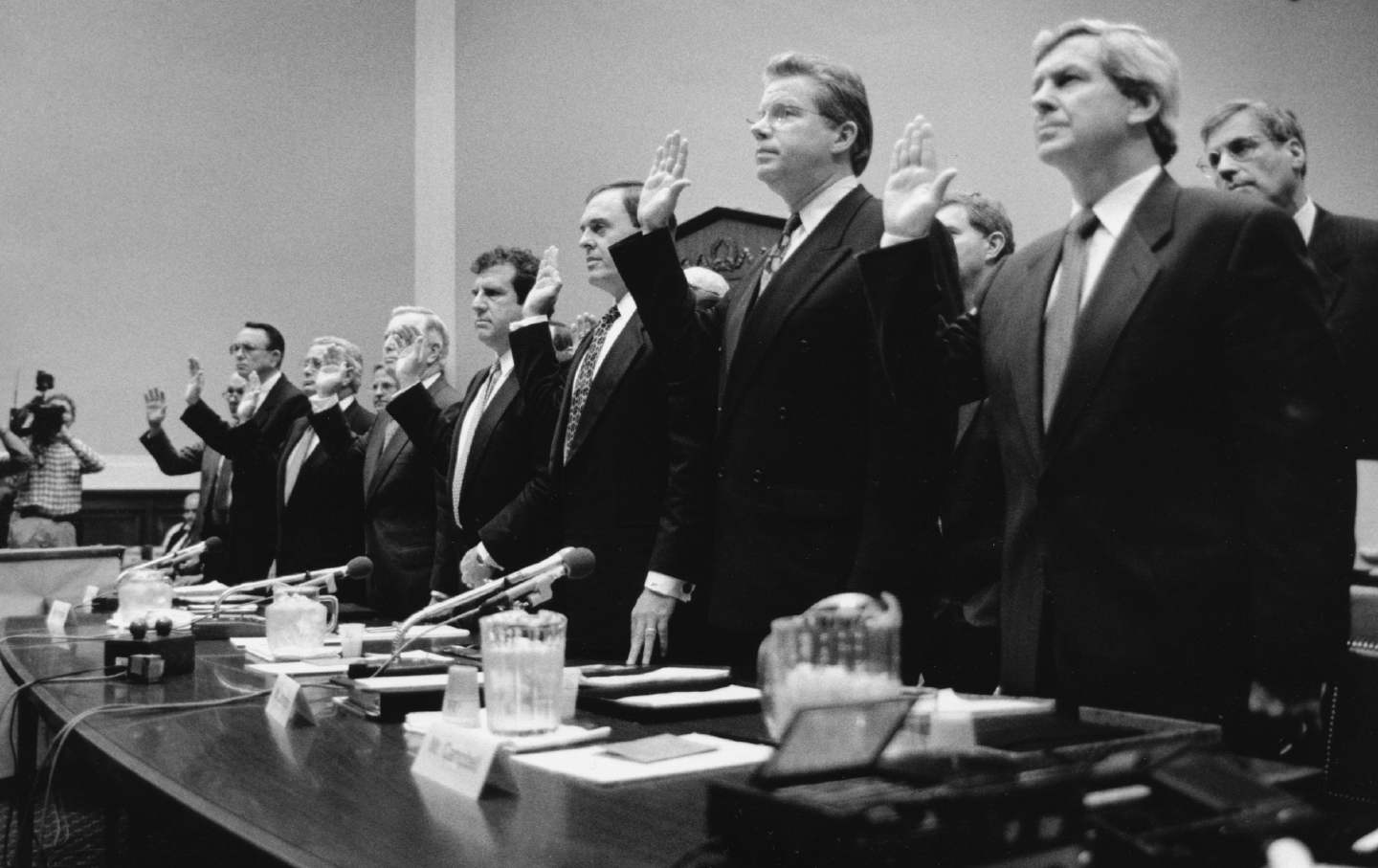
We’ve talked about ignorance you drift into, and ignorance you design. Now let’s talk about ignorance you deploy.
In 1994, seven tobacco company CEOs testified before Congress that they did not believe nicotine was addictive. This wasn’t designed ignorance or luxury ignorance. This was something else entirely. Internal documents later revealed that tobacco companies had known about nicotine’s addictive properties for decades. They had research. They had data. They had scientists telling them exactly what their products did.
They knew. And they structured their organizations so that the people making public statements could truthfully say “I don’t have personal knowledge of that” while the companies absolutely knew. They weaponized ignorance, turned “I don’t know” into a strategic shield against accountability.
This is the third kind of ignorance, and it’s the most dangerous because it corrupts the other two. Once weaponized ignorance becomes common, luxury ignorance becomes suspect and designed ignorance becomes impossible.
The Pattern
You’ve probably seen this one.
A manager at a software company notices that their team consistently hits their velocity targets quarter after quarter. Impressive, right? Except the production incident rate is climbing, technical debt is accumulating, and the on-call rotation is burning people out.
When asked about it, the manager says: “I don’t micromanage how the team hits their numbers. I trust them to make good technical decisions. My job is to clear obstacles and measure outcomes.”
This sounds reasonable. It sounds like delegation, maybe even like the designed ignorance we talked about in the last post; letting the people with technical expertise own the technical decisions.
This is where reality comes crashing in, because the manager knows the networks are being gamed. They know it because three different engineers have raised concerns about unsustainable practices. They know it because the incident reports are sitting in their inbox. They know it because the team’s tech lead resigned with a detailed exit interview about code quality and lack of accountability.
This is weaponized ignorance; what may appear to be delegation is actually strategic avoidance. They maintain plausible deniability while the problem festers and compounds.
The Tell
Here’s how you distinguish weaponized ignorance from the other kinds. Someone brings you information you don’t have. What happens next?
                       ┌─ Surprise ──── "I didn't realize..."
                       │                Luxury ignorance
                       │                (unconscious drift)
                       │
        Information ───┼─ Engagement ── "Tell me more..."
        arrives        │                Designed ignorance
                       │                (conditional, trigger activated)
                       │
                       └─ Deflection ── "I don't need to know."
                                        Weaponized ignorance
                                        (strategic, information is a threat)
That third branch is the dangerous one. The person deflecting isn’t passively uninformed. Instead, they’re actively structuring their attention, their questions, their organizational reporting to ensure they can comfortably say “I didn’t know” when the consequences arrive.
The Architecture of Strategic Ignorance
Weaponized ignorance gets built into organizational structures.
By the mid-1970s, Ford knew the Pinto had a design flaw that made it prone to fuel tank explosions in rear-end collisions. They knew because their own engineers tested it and documented it. They calculated that fixing it would cost about $11 per vehicle. They also calculated the expected cost of lawsuits from deaths and injuries.
They did a cost-benefit analysis that explicitly valued human lives in dollars and decided the lawsuits would be cheaper than the fix.
But here’s the key detail: the information flow meant that certain people in the organization could claim they didn’t have direct knowledge of this cost-benefit analysis. These people tended to be those who may be called to testify about the flaw. In this case, ignorance was distributed strategically to protect the company.
This wasn’t a case of certain people not needing to know; it was an organizational decision to make sure certain people could claim they didn’t know.
The Workplace Variants
You’ve probably seen versions of this:
| Pattern | What it sounds like | What’s actually happening |
|---|---|---|
| “Don’t Ask” | “I don’t need to know the details of our supply chain.” | Structuring oversight to avoid information that would obligate action |
| “I Trust You” | “I trust my team to write good code.” | Avoiding code reviews, test coverage, and production logs—avoidance disguised as delegation |
| “Just Give Me the Headlines” | “I only need the summary metrics.” | Filtering out uncomfortable details so they never have to be confronted |
| “I Don’t Take Sides” | “Both of you raise valid concerns.” | Using “neutrality” as cover for not engaging with evidence or doing the work of judgment |
The last one deserves special attention; on the surface it looks like fairness. What could be wrong with taking a neutral stance between two conflicting views?
The problem is that it is only rarely that both sides of an argument are valid. The rest of the time, this is “false equivalence” as strategic ignorance. When leaders treat all claims as equally valid to avoid doing the work of evaluation, they’re not being neutral. They’re using the appearance of fairness to avoid judgment.
Performed Ignorance as Control
Sometimes the goal isn’t avoiding accountability. Sometimes it’s raw dominance through strategic confusion.
In my case, I was working in-house at a small distribution company with an executive team that seemed to spend most of their time battling each other in passive aggressive ways. I’d been asked to mock up a website redesign as the old site had not been updated in years.
I presented this mockup at a meeting, and it immediately devolved into the typical sniping match. The marketing VP kept incredulously asking what that “strange wording” was. I’d used lorem ipsum, the placeholder text that literally everyone in design, marketing, and web development knows. I patiently tried to explain what lorem ipsum was and why it was used.
She went on. And on. Pretty soon I was in the position of defending what a mockup is rather than discussing the actual redesign.
She wasn’t stupid. She was cunning. She knew exactly what lorem ipsum was as I had seen copy provided by our ad agency using it. But by performing ignorance, by treating a universally understood convention as bizarre and confusing, she could derail the discussion, try and make me look foolish for not using “real content,” and ultimately block a project that came from a rival executive.
This is weaponized ignorance as theater. Forget plausible deniability. This is about control. By pretending not to understand something everyone understands, you can:
- Derail productive discussions
- Waste time on explaining basics
- Make the other person defend their competence rather than their ideas
- Assert dominance through the power to demand explanations for the self-evident
I see this constantly in technical discussions. The executive who keeps asking “but why can’t we just…” about something technically impossible, forcing engineers to explain basic computer science principles instead of discussing the actual problem. The manager who feigns confusion about industry-standard practices, making the team defend normal approaches instead of focusing on the work.
They understand fine. Pretending otherwise gives them power.
Plausible Deniability by Design
Another pattern: deploying strategic ignorance to push others toward unethical behavior while maintaining personal deniability.
At the same company, an executive asked me to create a brochure. I mocked it up with placeholder images and submitted it for approval. He approved it, so I started researching licensing for the graphics.
His response: “Isn’t there a way we can do this without paying that?”
I explained how copyright law worked (which he doubtless knew). He kept nudging me to just use the images without licensing them. All while maintaining deniability: “I don’t care where you get them, I don’t want to know, but I don’t want us to have to pay for them.”
He never said “steal the images.” He just made it clear that:
- He wanted the images in the brochure
- He didn’t want to pay for them
- He explicitly didn’t want to know how I accomplished this
This is weaponized ignorance as a liability shield. By saying “I don’t want to know,” he was:
- Making it clear what he expected me to do (violate copyright)
- Protecting himself from legal consequences
- Putting all the risk on me
The same executive later asked me to rip and burn CDs of an artist who had performed at a company event and self-published their work. Rather than spend $8 per CD, he wanted copies made. He never said “steal their music” but nobody could have been surprised by what he was hinting at.
The pattern is: “Get me the result. I don’t want to know how you do it. But it better not cost anything.” The willful ignorance is the point. It creates a buffer between the executive and the consequences while making it clear to the employee what’s expected.
Compare that with designed ignorance, where you genuinely don’t need the implementation details. This is deliberately not knowing so you can claim ignorance when something goes wrong while ensuring through context, tone, and pressure that the employee knows exactly what you want them to do. Add in the usual power differential between the person asking and the person expected to perform, and you immediately can see how problematic this can become.
The Pattern Everywhere
This isn’t limited to the workplace. The same structure shows up across domains:
| Domain | The Setup | The Shield | The Cost |
|---|---|---|---|
| Pharmaceutical | Companies choose passive side-effect reporting over thorough investigation — not better methodology, just less documentation | “These side effects were unknown or rare” | Addiction risks go unaddressed because structured data collection ensured companies never “officially” knew |
| Academic | A senior researcher takes co-author credit without examining raw data, even after warning signs and raised concerns | “I trusted my student. That’s not unusual in large labs” | Fraudulent results persist, benefiting the person who made sure not to look |
| Consumer | A product has glowing reviews, many from people who received it free. You could investigate the patterns—or not | “They say they’re honest reviews. Who am I to judge?” | You treat claims deserving different scrutiny as equally valid because investigation would complicate your purchase |
The scale varies enormously, but the mechanism is identical: structuring your attention to avoid information that would obligate you to act differently.
How It Spreads
Weaponized ignorance doesn’t stay contained. It corrupts the other kinds.
When managers start using “I don’t micromanage” as cover for avoiding accountability, it makes actual delegation suspect. Engineers stop trusting that their judgment will be respected because they’ve seen “I trust your technical decisions” used as a shield when things go wrong.
When executives structure their organizations to maintain plausible deniability, it breaks designed ignorance. The whole point of designed ignorance is that when information needs to cross boundaries, it can. But if the boundaries exist to prevent information flow rather than enable specialization, the system stops working.
When leaders use “I don’t have direct knowledge of that” as a legal defense, it creates pressure to not know things. People stop documenting problems. They stop escalating concerns. They learn that information is dangerous.
This is how organizations become willfully blind. It starts with a few people cultivating willful blindness, and it metastasizes into a culture where everyone knows not to look too closely at anything.
The Relationship to Power
Weaponized ignorance is almost always a privilege of position. The ability to maintain strategic ignorance correlates directly with distance from consequences:
        Who CAN'T say                          Who CAN say
        "I don't need to know"                 "I don't need to know"

        Junior engineer                        Executive
        ..."how the database works"            ..."our supply chain labor practices"

        On-call operator                       Director of Engineering
        ..."why this service is failing"       ..."how this gets implemented"

        Warehouse worker                       VP
        ..."what's in these boxes"             ..."how the team hits these metrics"

        ← Can't afford not to know              Can afford not to know →
In hierarchical organizations, this becomes self-reinforcing. It flows downward. The executive who weaponizes ignorance teaches managers to weaponize ignorance, who teach leads to weaponize ignorance. Eventually you have an entire organization where “I don’t know and I don’t want to know” becomes the default response to uncomfortable information.
In my case with the copyright situation, I was the one who would have faced legal consequences for using unlicensed images. The executive maintained all the power (approving the final product, controlling my employment) while transferring all the risk to me through strategic ignorance. That’s the pattern: power flows up, risk flows down, and strategic ignorance is the mechanism that enables the transfer.
The Cost
Boeing’s 737 MAX had a flight control system called MCAS that could push the aircraft’s nose down based on a single angle-of-attack sensor. Boeing engineers raised concerns internally. Test pilots flagged unexpected behavior. The information was there.
But Boeing had structured its entire certification process to minimize what regulators and airlines would “officially” know about MCAS. They pushed to classify the MAX as a derivative of the existing 737 rather than a new aircraft, which meant less scrutiny. They minimized MCAS in pilot training documentation so airlines wouldn’t require expensive simulator training. They used their role in the FAA’s delegated certification program to effectively oversee their own safety assessments.
The people who could have grounded the aircraft didn’t know enough to act. The people who knew enough to act didn’t have the authority. And the people with both the knowledge and the authority had structured their information flow so they could maintain distance from the details.
Three hundred forty-six people died across two crashes with Lion Air Flight 610 and Ethiopian Airlines Flight 302 because an organization made strategic decisions about who would know what, and when, and how much. The fact that these were airlines based in developing nations played into the power differential, as Boeing implied that Lion Air and Ethiopian Airlines had lower standards and training than American or European carriers.
Recognizing It In Yourself
This is the hard part. Luxury ignorance is relatively easy to spot. It’s that moment when you realize you didn’t think about the consequences. Weaponized ignorance is harder because it’s strategic. You’re not accidentally ignorant; you’re deliberately maintaining ignorance.
Here are the questions I try to ask myself:
- Am I avoiding asking because I don’t want to know the answer? “I trust the team to handle it” — genuine delegation, or avoiding information that would complicate my life?
- Am I structuring my attention to maintain deniability? Skipping meetings, avoiding reports, not asking questions — so I can say “I wasn’t aware of that”?
- Do I treat all claims as equally valid to avoid judgment? “Both sides raise good points” — because they actually do, or because evaluating them would be uncomfortable?
- Do I punish people who bring me information I don’t want? When someone raises a concern, do I engage — or make it clear I don’t want to hear about problems?
- Am I using “I don’t want to know” to transfer risk? When I say “handle it,” am I trusting their expertise or creating deniability while putting them at risk?
- Would I defend this ignorance in public? Would my answer be “the system is designed for someone else to know” (designed) or “I made sure not to look” (weaponized)?
Where I’ve Failed These Tests
I catch myself regularly. I’ll treat two competing technical proposals as equally valid because deeply evaluating them would take time I don’t want to spend. I’ll say “I trust you to make the right call” when what I mean is “I don’t want to be responsible for this decision.”
Looking back at my time at that distribution company, I also practiced my own forms of willful blindness. I didn’t ask questions about certain concerning events and practices because I didn’t want to confront how dysfunctional things really were. I tried to avoid interacting with certain executives because I didn’t want to be pulled into their political battles. I kept my head down and pretended not to see things that would have obligated me to act.
The trying matters because the alternative — strategic ignorance becoming automatic, invisible even to yourself — is worse.
Building Systems That Resist It
You can’t eliminate weaponized ignorance through individual virtue. It has to be addressed systemically.
Make information flow mandatory, not optional. In aviation, certain callouts are required, not suggested. The pilot monitoring must announce certain conditions. The pilot flying must acknowledge them. There’s no “I didn’t hear that” defense because the system doesn’t allow it. What are the equivalent mandatory callouts in your organization?
Separate evaluation from consequences. One reason people weaponize ignorance is fear that knowing obligates them to act in ways they can’t afford. If looking at diversity metrics means you have to hit targets you can’t meet, you won’t look. But if looking at metrics is separated from immediate action requirements, if it’s “we need to understand the problem before we can solve it”, people are more likely to engage.
Reward people who surface problems. If raising concerns gets you labeled as “not a team player” or “too negative,” people learn to weaponize ignorance. If surfacing problems early gets you recognized for preventing disasters, people learn to look.
Make willful ignorance more costly than knowledge. Right now, in many organizations, it’s safer not to know. You need to invert that. Make it riskier to say “I wasn’t aware” than to say “I knew and here’s what I did about it.”
Document the things people avoid knowing. When someone repeatedly deflects information, document it. When someone structures their role to avoid certain knowledge, make that structure visible. Weaponized ignorance thrives in opacity.
Distinguish “I don’t need to know” from “I don’t want to know.” The first is potentially legitimate designed ignorance. The second is weaponized ignorance. Make people articulate why they don’t need to know something. If the answer is “because knowing would be uncomfortable” rather than “because someone with more expertise owns this,” you’ve found the pattern.
Create accountability for risk transfer. When leaders use “I don’t want to know how you do it” to push ethical or legal risk onto employees, make that visible and costly. The person with the power should carry the risk, not the person doing the work.
The Uncomfortable Truth
Here’s what I’ve learned trying to spot weaponized ignorance in myself: it’s almost never dramatic. It’s not the tobacco company CEO lying to Congress. It’s not the executive covering up safety defects.
It’s the small deflections. Not looking at the Jira backlog because you know it’s full of technical debt you don’t have time to address. Not asking about team morale because you don’t have headcount to reduce workload. Saying “I trust your judgment” when someone’s trying to get you to make a difficult call. Saying “I don’t want to know where you get them” so you can maintain deniability while someone else takes the risk.
Most of the time these aren’t evil. They’re human. But each small deflection makes the next one easier. Each avoided conversation makes avoidance feel more natural. Each time you get away with “I didn’t know,” the strategy reinforces itself.
We started this series with awareness, a way of seeing your blast radius. Then design, building systems where knowledge flows to the right people. Weaponized ignorance demands something harder: honesty about when your ignorance is a choice.
That means catching yourself in the moment of deflection and asking: “Am I not asking because I don’t need to know, or because I don’t want to know?”
It means recognizing that “I didn’t know” covers a lot of ground. Sometimes it’s a system that broke down. Sometimes it’s attention that drifted. Sometimes it’s a choice you made. The first step is being honest about which one you’re actually dealing with.
The water flows. You can let it hold you down (luxury ignorance). You can channel it deliberately (designed ignorance). Or you can build dams to keep certain water from reaching you at all (weaponized ignorance).
Whatever you’re protecting by not looking, it isn’t worth what it costs everyone else.
Related Reading
- Previous in Series: Designed Ignorance - When not knowing is actually the system working as designed
- First in Series: The Luxury of Ignorance - When we choose not to know, and why giving up that comfort matters
- Communication: Breaking Down Silos - How Crew Resource Management principles can improve team communication
- Systems Failures: The Quiet Collapse of Standards - How normalization of deviance erodes the boundaries that designed ignorance depends on